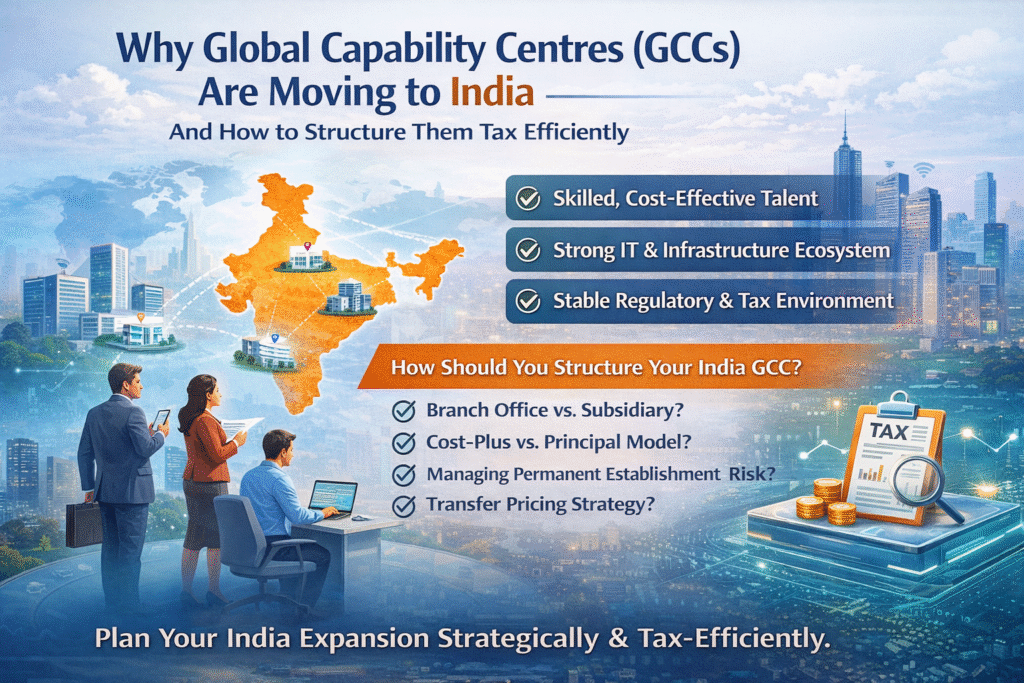
Over the past 3 years, India has become the global hotspot for setting up Global Capability Centres (GCCs).
What started as back-office cost arbitrage has evolved into something far more strategic.
Today, multinational companies are setting up India GCCs for:
• Finance & accounting
• IT & product development
• R&D centres
• Legal & compliance support
• Data analytics & AI
• Procurement & global operations
And the trend is accelerating — especially among European companies looking to optimise cost structures while maintaining quality.
But here’s the part most businesses underestimate:
Setting up a GCC is not just an operational decision — it is a tax structuring decision.
Why India Has Become the GCC Capital
India offers:
✅ Deep skilled talent pool
✅ Strong IT ecosystem
✅ Cost advantage vs EU/US
✅ Mature compliance infrastructure
✅ Stable legal & tax framework
✅ Large DTAA network
For companies in markets like Germany and across Europe, India is not just a support centre anymore — it’s becoming a strategic value driver.
The Real Question: How Should a GCC Be Structured?
When a foreign company decides to establish a GCC in India, the structure typically falls into one of three models:
1️⃣ Branch Office Model
2️⃣ Wholly-Owned Subsidiary Model
3️⃣ Third-Party / Captive Service Model
Each has very different tax and risk implications.
1️⃣ Branch Office Model – High Risk for Most GCCs
A Branch Office creates a Permanent Establishment (PE) exposure in India.
That means:
• Profits attributable to India are taxable
• Higher foreign company tax rate applies
• Parent company remains fully liable
• Head office cost allocation becomes contentious
• Increased litigation risk
For long-term GCC operations, this structure is rarely optimal.
2️⃣ Indian Subsidiary Model – The Preferred Structure
Most global companies choose a Wholly-Owned Indian Subsidiary.
Why?
✔ Lower corporate tax regime (~22–25%)
✔ Limited liability
✔ No PE exposure for parent
✔ Easier scaling
✔ Eligible for state incentives
✔ Clear transfer pricing framework
The subsidiary typically operates under a cost-plus model, charging the parent company for services rendered.
This provides:
• Predictable tax position
• Clean documentation
• Reduced litigation exposure
3️⃣ Cost-Plus vs Principal Model – The Strategic Choice
The real tax planning lies in deciding:
👉 Should India operate as a cost centre?
👉 Or as a value-creating principal entity?
Cost-Plus Model
• India earns fixed markup (say 10–15%)
• Limited risk
• Stable margins
• Lower scrutiny
Principal / Entrepreneur Model
• India bears risk
• Higher potential profits
• Higher tax exposure
• More complex transfer pricing
For most European GCCs starting out, a cost-plus captive model works best.
The 5 Biggest Tax Mistakes Companies Make While Setting Up a GCC
- Ignoring PE exposure from remote employees
- Choosing Branch over Subsidiary without modelling tax impact
- Poor transfer pricing documentation
- Not planning profit repatriation strategy
- Ignoring GST implications on inter-company services
These mistakes can cost millions over time.
Why This Matters More in 2026
With increasing India–Europe trade alignment and rising compliance scrutiny globally:
• Tax authorities are more aggressive on PE matters
• Transfer pricing audits are increasing
• Substance requirements are tightening
• Global minimum tax (OECD Pillar 2) is reshaping cross-border strategy
GCC structuring is no longer just a finance decision — it’s a board-level strategic move.
Final Thought
India is no longer just a cost arbitrage destination.
It is becoming a global operating hub.
But without proper tax structuring, what looks like a smart expansion can quickly become a compliance and litigation headache.
If you’re evaluating setting up a GCC in India, structure it right from day one.
FAQs on Setting Up a GCC in India
Q1. What is a Global Capability Centre (GCC)?
A GCC is a captive centre set up by a multinational company to provide services such as IT, finance, R&D or analytics.
Q2. Is a subsidiary better than a branch for GCC in India?
In most cases, a wholly-owned Indian subsidiary is more tax efficient and reduces PE exposure.
Q3. What is the tax rate for a GCC in India?
Indian subsidiaries are taxed at 22–25% (subject to regime chosen).
Q4. What is a cost-plus model in GCC structuring?
It is a transfer pricing method where the Indian entity earns a fixed markup over operating costs.
At PGA & Co. Chartered Accountants, we assist multinational companies with:
• India GCC structuring
• Subsidiary incorporation
• Transfer pricing planning
• PE risk management
• Ongoing cross-border compliance
Planning to set up a GCC in India?
Talk to India entry and tax structuring experts at https://pgaca.in/contact-us/
Or book a consultation today.
#GCCIndia #GlobalCapabilityCentre #IndiaExpansion #InternationalTax #TransferPricing #CrossBorderBusiness #FDIIndia #TaxStrategy #IndiaEU #GlobalBusiness #CharteredAccountants